You certainly need to eat more whole grain but here’s the truth: not all “whole grain” products are created equal.
Some are healing. Others are cleverly disguised refined carbs that quietly feed inflammation.
So how do you tell the difference?
Let me walk you through what really matters—not just on the label, but in your body.
The “10:1 Rule”: Your Grocery Store Hack
When you’re standing in the bread or cereal aisle, reading nutrition labels can feel confusing. Front packages love to brag about being “Made with Whole Grains!”—even when the product is packed with sugar and refined flour.
To cut through the noise, researchers at the Harvard School of Public Health came up with a simple trick called the 10:1 Rule:
For every 10 grams of total carbohydrates, look for at least 1 gram of dietary fiber.
Total Carbs ÷ Dietary Fiber = Your Score
(You want your score to be 10 or LOWER!)
Why Does This Rule Work?
When Harvard evaluated hundreds of grain products, they found that foods meeting this 10 to 1 ratio were consistently:
-
Lower in sugar and added junk
-
Higher in essential minerals like magnesium and zinc
-
Better at preventing blood sugar spikes
When you slow down those blood sugar spikes with good fiber, you help keep your body’s immune system calm. Over time, eating high-quality fiber helps lower key markers of chronic inflammation in your blood (like C-reactive protein, or CRP).
Let’s Put It to the Test
You don’t need a calculator—just look at the Total Carbohydrates and Dietary Fiber lines on the Nutrition Facts panel:
-
Standard White Bread: 15g carbs, 1g fiber $\rightarrow$ 15:1 Ratio ❌ (Fails the test — fast sugar, low fiber)
-
Basic “Whole Wheat” Bread: 15g carbs, 3g fiber $\rightarrow$ 5:1 Ratio (Passes the test — a solid, acceptable choice)
-
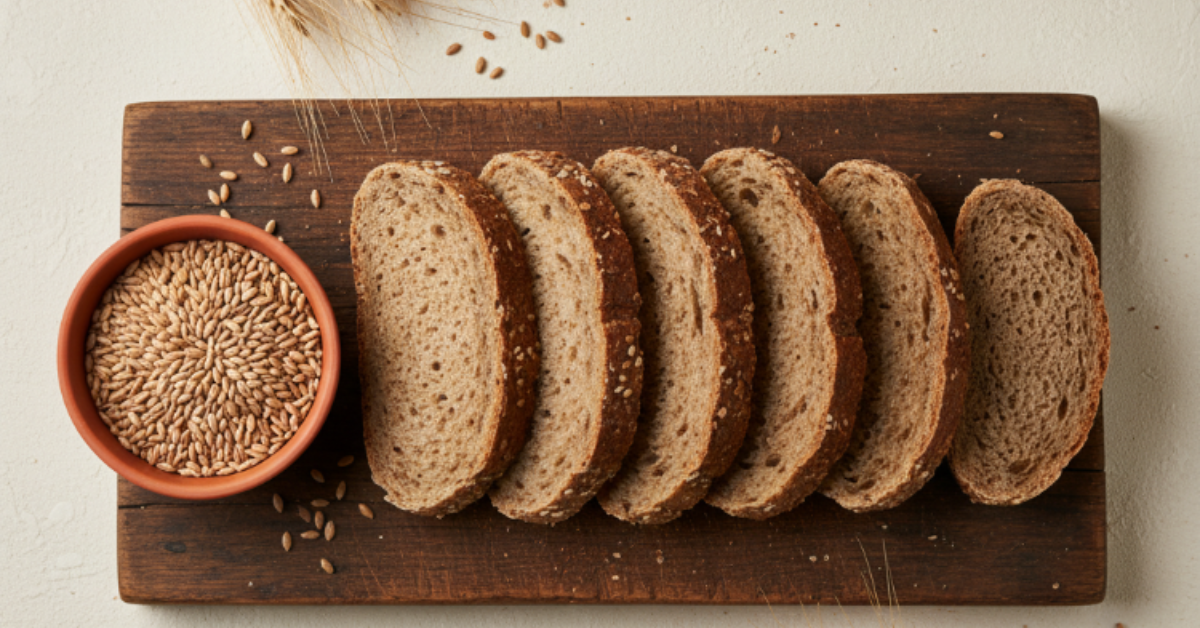
Sprouted Grain Bread: 20g carbs, 6g fiber $\rightarrow$ 3.3:1 Ratio (Crushes the test — excellent fiber quality)
But Ratio Alone Isn’t Enough: Watch Out for “Fake Fiber”
While the 10:1 Rule is a fantastic first filter, food manufacturers have figured out a sneaky workaround.
To make processed foods look healthy on paper, companies often take heavily refined flour and blast it with isolated fibers—like inulin, chicory root extract, or soluble corn fiber. This helps the box hit a great carb-to-fiber ratio, but it doesn’t give you the benefits of a real whole grain.
As Dr. David Rakel highlights in Integrative Medicine:
“Refining wheat removes 200–300-fold of natural plant compounds that protect your cells.”
When you strip away the natural structure of the grain (the bran, germ, and endosperm), adding isolated fiber back in simply cannot replace what was lost.
Why Isolated Fiber Can’t Beat Intact Grains
| Isolated Fiber (Added in a Lab) | Intact Whole Grains (Nature’s Way) |
| ❌ Lacks natural antioxidants and cellular-protecting phytonutrients. | ✅ Packed with cell-protecting polyphenols and Vitamin E. |
| ❌ Digests quickly, leading to faster blood sugar spikes. | ✅ Forms a physical barrier that slows down sugar absorption. |
| ❌ Feeds only a narrow group of gut bacteria. | ✅ Feeds a broad diversity of healing gut microbes. |
According to research from the Harvard T.H. Chan School of Public Health, intact grains provide a complex food matrix where fiber, vitamins, minerals, and phytonutrients work together synergistically.
Furthermore, clinical reviews published in the National Institutes of Health (NIH / PubMed Central) confirm that intact cereal fibers are far more effective at improving insulin sensitivity, promoting fullness, and reducing systemic inflammation than added functional fibers.
The Bottom Line
The next time you grab a box of crackers, pasta, or a loaf of bread, do a quick “10 to 1” check.
If the fiber number isn’t at least one-tenth of the total carbs, put it back. And if it does pass the test, double-check the ingredients list: make sure the first ingredient is a real, intact whole grain—like steel-cut oats, whole rye, quinoa, or sprouted whole wheat—so you get the genuine anti-inflammatory protection your body deserves.