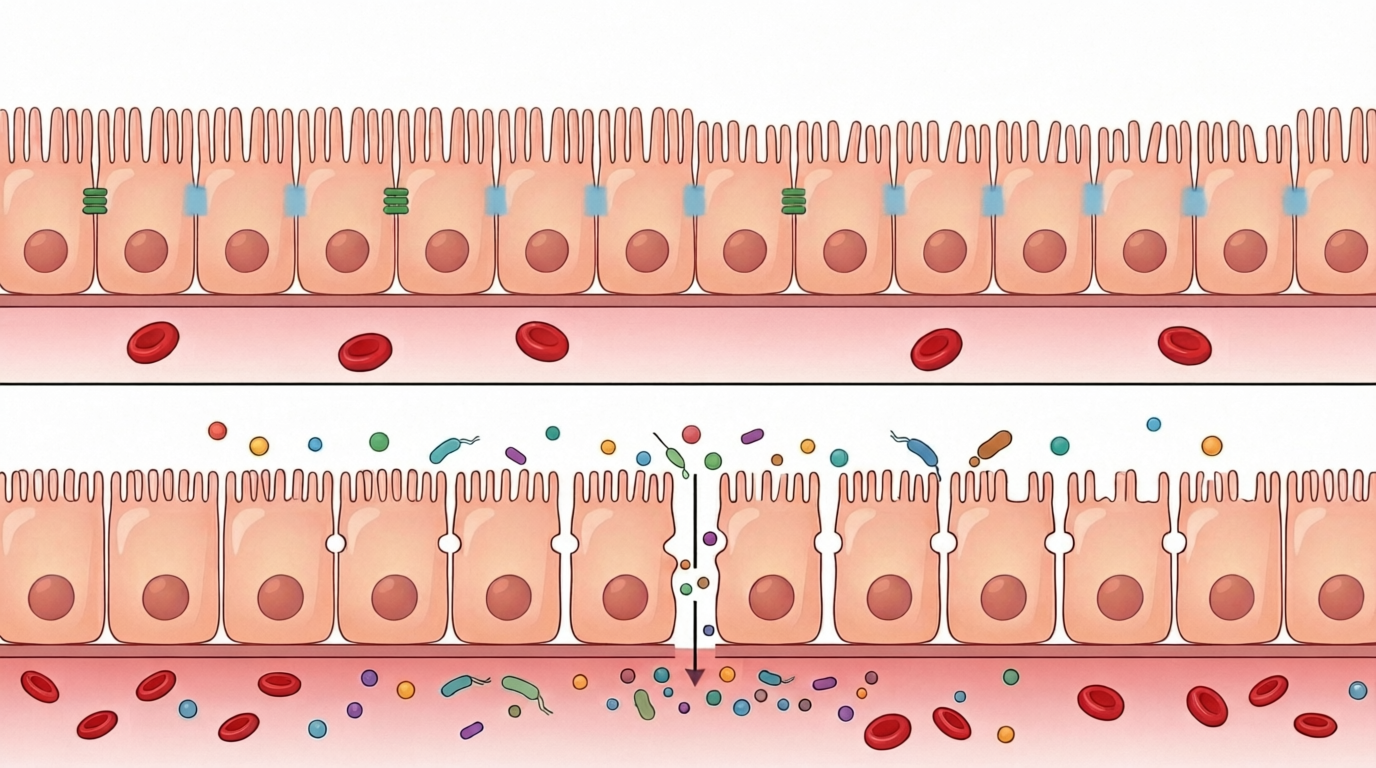
Quick Answer: Increased intestinal permeability—commonly known as “leaky gut”—occurs when the tight junctions binding your intestinal lining become compromised. This allows undigested food particles, bacterial endotoxins (LPS), and toxins to escape into the bloodstream, triggering systemic inflammation. It is a documented physiological shift driven by specific dietary, chemical, and lifestyle triggers.
If you have been eating clean, eliminating gluten, taking daily probiotics, and yet still struggle with brain fog, post-meal bloating, chronic fatigue, or unexplained joint stiffness—you are not imagining things.
You are not broken. Your body is simply responding to hidden stressors in its environment.
What you are experiencing has a clear, science-backed name: increased intestinal permeability. While often dismissed by conventional approaches that focus solely on symptom management, it is a physiological shift detailed in standard textbooks like Guyton & Hall Textbook of Medical Physiology and supported by extensive peer-reviewed literature.
Let us look at the five root-cause triggers I evaluate most frequently in clinical practice—especially in thoughtful, health-conscious individuals who feel they have “done everything right” yet remain stuck.
1. Gluten Exposure (Beyond Celiac Disease)
Gluten does not only impact individuals with diagnosed Celiac disease. Upon ingestion, gluten stimulates the epithelial release of zonulin—a regulatory protein that signals the tight junctions between intestinal cells to temporarily open.
In sensitive individuals, these biological gates remain open far longer than intended, transforming a controlled barrier into an open threshold.
| Condition | Mechanism of Action |
| Celiac Disease | Autoimmune destruction of intestinal villi triggered by gluten. |
| Non-Celiac Sensitivity | Prolonged zonulin activation causing sustained tight junction dysfunction. |
Many processed “gluten-free” alternatives rely on refined starches, cross-contaminated oats, or additives that continue to drive low-grade intestinal irritation.
2. Emulsifiers in Processed “Health” Foods
Many shelf-stable almond milks, protein bars, and organic plant-based desserts rely on industrial emulsifiers such as polysorbate-80 and carboxymethylcellulose.
While these compounds keep ingredients uniformly mixed, they simultaneously act as detergents within the digestive tract, thinning the mucosal lining that protects delicate epithelial cells from bacterial exposure.
| Ingredient | Biological Impact on Gut Barrier |
| Polysorbate-80 | Disrupts protective mucus layer; promotes bacterial translocation. |
| Carboxymethylcellulose | Reduces microbial diversity; triggers low-grade epithelial inflammation. |
A product can carry an “organic” or “clean” label while still containing chemical additives that disrupt your barrier integrity.
3. Chronic Neuroendocrine Stress
Stress is not merely an emotional state; it is a physiological event that directly alters gut barrier function.
When systemic cortisol levels remain chronically elevated, splanchnic blood flow decreases, depriving enterocytes of the oxygen and nutrients needed to repair cell junctions.
| Stress Mechanism | Cellular Consequence |
| Reduced Splanchnic Flow | Impaired cellular repair and epithelial regeneration. |
| Systemic Endotoxemia | Bacterial fragments enter circulation, fueling further systemic inflammation. |
Healing intestinal permeability requires more than dietary changes—it demands nervous system regulation and intentional physiological rest.
4. Non-Steroidal Anti-Inflammatory Drugs (NSAIDs)
Over-the-counter NSAIDs like ibuprofen reduce acute pain by inhibiting cyclooxygenase (COX) enzymes, which decreases prostaglandin production.
However, prostaglandins are essential for maintaining gastric mucosal blood flow and protective mucus secretion. Inhibiting them compromises the gut’s natural defenses against gastric acid and digestive enzymes.
| Usage Pattern | Physiological Risk |
| Acute NSAID Use | Transient reduction in protective mucus and micro-vessels. |
| Chronic NSAID Use | Sustained barrier disruption, micro-tears, and systemic inflammatory loops. |
Relying on NSAIDs to manage joint pain caused by systemic inflammation can inadvertently worsen the barrier disruption driving that inflammation.
5. Dysbiosis and Reduced Microbial Diversity
Intestinal health relies on ecosystem balance, diversity, and function rather than a simple binary of “good” versus “bad” microbes.
When beneficial bacterial populations are depleted—whether from historical antibiotic use, low dietary fiber, or environmental toxins—opportunistic organisms can produce enzymes that degrade mucosal defenses.
| Microbiome State | Effect on Gut Barrier |
| High Diversity & SCFA Production | Short-chain fatty acids (like butyrate) nourish epithelial cells and reinforce junctions. |
| Low Diversity & Dysbiosis | Degradation of mucin layers and elevated exposure to inflammatory cell walls. |
Restoring permeability requires rebuilding microbial diversity and supporting ecosystem function, rather than focusing solely on antimicrobial protocols.
The 4R Framework for Restoring Barrier Function
Understanding intestinal permeability empowers you to take structured, intentional steps toward recovery using a functional 4R approach:
-
Remove: Eliminate dietary irritants, unnecessary NSAIDs, emulsifiers, and hidden food sensitivities.
-
Replace: Support digestive capacity with appropriate digestive enzymes or stomach acid support if clinically indicated.
-
Reinoculate: Nourish the microbiome using diverse fermentable fibers, polyphenols, and targeted probiotic strains.
-
Repair: Supply foundational nutrients—such as L-glutamine, zinc carnosine, and omega-3 fatty acids—to support epithelial regeneration.
In My Clinical Practice
When patients present with symptoms that feel disconnected—such as simultaneous joint pain, brain fog, and digestive distress—we look beyond symptom suppression to evaluate barrier integrity.
True recovery does not come from restrictive diets or short-term fixes. It comes from systematically identifying root triggers and giving your body the conditions it needs to repair itself.
You are not broken. By making intentional adjustments to remove these underlying triggers, you allow your body to regain balance, resilience, and strength.
Frequently Asked Questions
Is “leaky gut” an official medical diagnosis? In conventional medicine, it is referred to as increased intestinal permeability. It is a well-documented physiological state measured via specific biomarkers and discussed extensively in peer-reviewed medical literature.
Does gluten affect intestinal permeability if you do not have Celiac disease? Yes. Research demonstrates that gluten triggers zonulin release in human intestinal tissue regardless of Celiac status, though the duration and severity of tight junction opening varies by individual sensitivity.
How do stress and cortisol affect the gut barrier? Chronic stress diverts blood flow away from the digestive tract, impairing the enterocytes’ ability to produce ATP, synthesize mucin, and repair structural tight junctions.
What is the primary danger of taking daily NSAIDs for pain? NSAIDs inhibit prostaglandins that maintain the gut’s protective mucus layer and blood supply. This can cause micro-tears in the intestinal lining, increasing permeability over time.