A normal total cholesterol number doesn’t guarantee a healthy heart, because total cholesterol doesn’t distinguish between LDL that’s simply present and LDL that’s been damaged, or oxidized, which is the form most strongly linked to artery damage. Asking your doctor about oxidized LDL, particle number, or apoB testing can reveal risk that a standard cholesterol panel misses entirely.
Have you ever walked out of a doctor’s office relieved because your cholesterol number came back “normal,” only to later hear about someone with that exact same number who ended up with a heart attack anyway.
Have you wondered how that’s even possible, if the number was supposed to mean you were fine?
If that question has crossed your mind, you were noticing something real. Total cholesterol was never designed to tell the whole story, it just became the number everyone got used to talking about.
What Cholesterol Actually Is, in Plain Terms
Before going further, it helps to ask what cholesterol even is, because most people have heard the word for years without ever really being told.
Cholesterol is a waxy, fat-like substance your body needs. It builds cell walls, makes hormones, and produces vitamin D, so despite its reputation, you couldn’t survive without it.
Because cholesterol doesn’t dissolve in blood on its own, your body wraps it in protein carriers to move it around. LDL and HDL are really just two different carriers, not two different types of cholesterol.
LDL carries cholesterol out to your tissues, and HDL carries extra cholesterol back to the liver. That’s roughly why LDL earned the nickname “bad” and HDL the nickname “good,” though the real story is more complicated than that.
Why Total Cholesterol Doesn’t Tell You Enough
A standard cholesterol panel reports your total cholesterol, LDL, HDL, and triglycerides. For decades this was treated as the main tool for judging heart disease risk.
But total cholesterol simply adds these numbers together without asking a more important question: what condition is that LDL actually in?
Not all LDL behaves the same way once it’s circulating through your bloodstream. This is exactly where the story most people were never told begins.
What Oxidized LDL Actually Is
LDL becomes a problem specifically when it gets oxidized, meaning it’s been damaged by unstable molecules called free radicals. Think of it like the way metal rusts when exposed to oxygen over time.
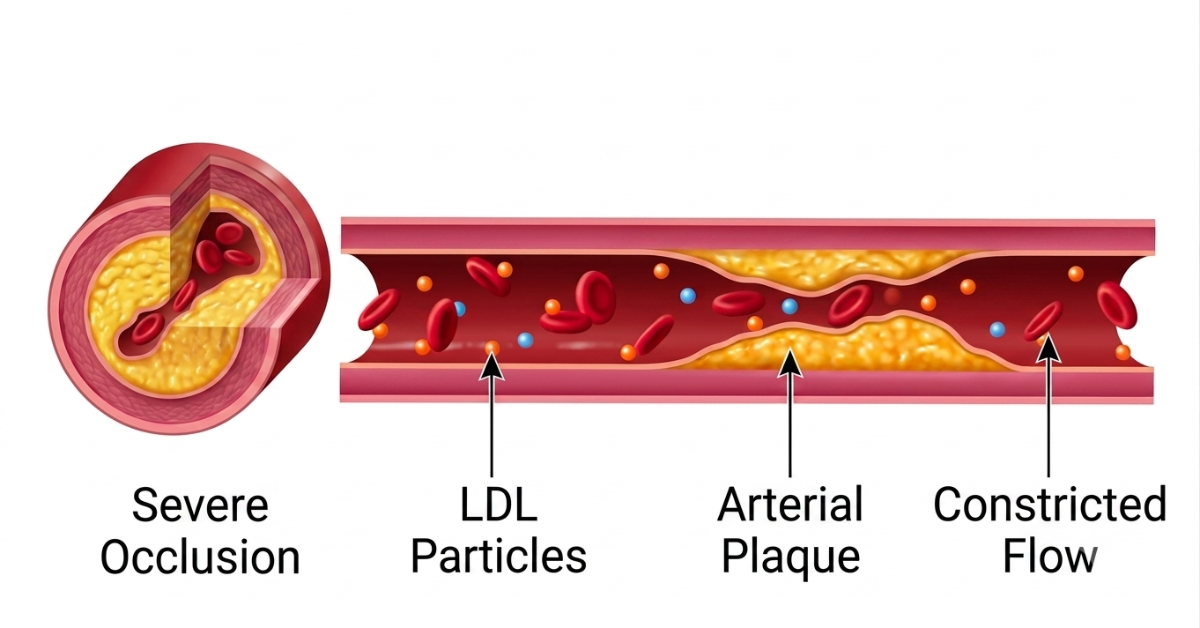
Regular, undamaged LDL can move through your bloodstream without necessarily causing harm. Oxidized LDL behaves very differently, it’s more easily trapped inside artery walls.
Once trapped, it triggers an inflammatory response as your immune system tries to clean it up, sending in cells that engulf the oxidized LDL.
Those cells eventually turn into what’s called foam cells, the building blocks of the fatty plaques that narrow arteries over years and can eventually rupture, triggering a heart attack or stroke.
A total cholesterol test can’t tell you how much of your LDL is in this damaged state. Two people can have identical total cholesterol numbers and dramatically different actual risk.
Standard Panel vs. Advanced Testing
| Test | What It Measures | What It Misses |
|---|---|---|
| Total Cholesterol | Sum of LDL + HDL + 20% of triglycerides | Doesn’t distinguish healthy LDL from oxidized/damaged LDL |
| Standard LDL/HDL | Cholesterol carried by each particle type | Says nothing about particle number or particle size |
| Oxidized LDL Test | Directly measures damaged, oxidized LDL | Not run by default — must be requested |
| ApoB | Actual number of LDL particles in circulation | Also not run by default |
| Advanced Lipid Panel (NMR) | LDL particle size and density (small/dense vs. large/buoyant) | Requires a specialty lab, not always covered by insurance |
What Actually Drives LDL Oxidation
LDL doesn’t oxidize randomly. It tends to happen more under certain conditions: chronic inflammation, high blood sugar, and smoking.
A diet heavy in processed omega-6 oils and refined carbohydrates, covered in earlier pieces on this blog, also increases how much of your LDL ends up oxidized.
This is part of why cholesterol and inflammation are so tightly connected, and why fixing one so often improves the other.
What to Actually Ask Your Doctor
A standard cholesterol panel isn’t useless, it’s a reasonable starting point. But if you want a fuller picture, especially with a family history of heart disease, it’s worth asking for more.
Ask specifically about an oxidized LDL test, or about apoB, which measures the actual number of LDL particles rather than just the cholesterol they’re carrying.
You can also ask about an advanced lipid panel that breaks LDL down by particle size and density, since smaller, denser particles are more prone to oxidation.
These tests aren’t always run automatically, so it often takes asking directly. That’s a completely reasonable thing to bring up at your next appointment.
In My Clinical Practice
I’ve seen this scenario more times than I can count: a patient with a total cholesterol number that looks entirely unremarkable.
Yet once we looked further, at inflammation markers, particle number, and oxidative stress, a very different risk picture emerged, one a standard panel alone would have missed.
This isn’t about frightening anyone away from a normal-looking lab result. It’s about knowing that number was never meant to be the whole conversation.
You don’t need to fear cholesterol. You need to ask better questions about it.
FAQ
Is total cholesterol a reliable measure of heart disease risk? It’s a reasonable starting point, but total cholesterol doesn’t distinguish between healthy LDL and oxidized LDL, which is far more strongly linked to artery damage. Two people with identical total cholesterol can have very different actual risk.
What is oxidized LDL? Oxidized LDL is LDL cholesterol that has been damaged by free radicals. Unlike regular LDL, it’s more easily trapped in artery walls, where it triggers inflammation and contributes to the plaque buildup that can lead to heart attack or stroke.
What causes LDL to become oxidized? Chronic inflammation, high blood sugar, smoking, and diets high in processed omega-6 oils and refined carbohydrates are all associated with higher rates of LDL oxidation.
What tests should I ask my doctor about besides standard cholesterol? Consider asking about an oxidized LDL test, apoB (which measures LDL particle number), or an advanced lipid panel that reports LDL particle size, especially if you have a family history of heart disease.